
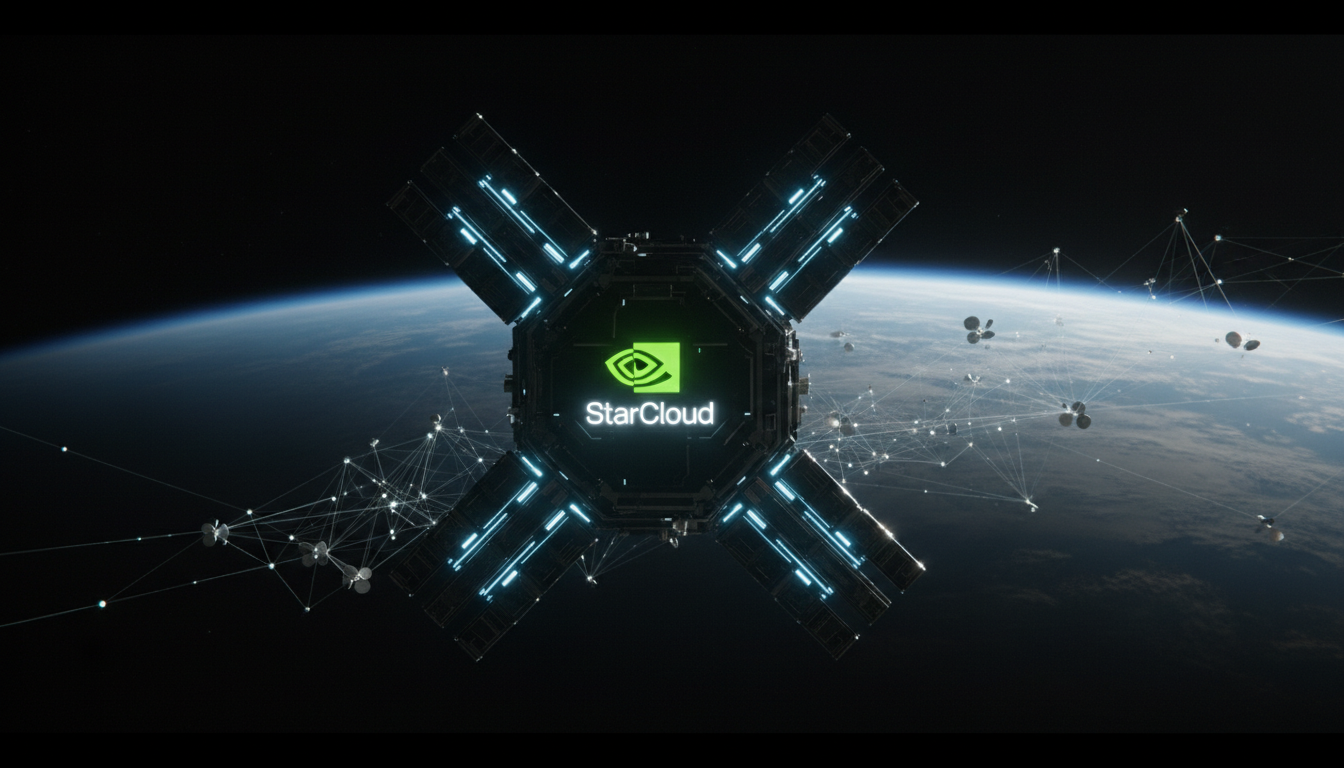
History was made this morning as Nvidia, in partnership with the orbital infrastructure firm StarCloud, announced the successful deployment and training of Astra, the first large-scale AI model developed entirely in space. Operating from a specialized Compute-Sat positioned in Low Earth Orbit, Astra utilized the naturally near-zero temperatures of the void to cool its massive processing arrays, bypassing the energy-intensive cooling systems required by terrestrial data centers. This milestone proves that the Final Frontier is not just for exploration, but for the next generation of industrial-scale computing. The breakthrough has sent shockwaves through the global business community, with Nvidia stock hitting a record high as investors realize the implications of Gravity-Free Inference amidst a turbulent global economy. By processing data on-orbit, Astra can provide real-time analysis for global climate monitoring, maritime logistics, and emergency response with zero latency to the source. StarCloud officials noted that the Space-Born AI is thirty percent more efficient than its Earth-based counterparts, primarily because it does not have to fight the planet’s atmospheric thermal trap. Beyond the efficiency gains, the launch of Astra marks a significant shift in entertainment and media trends. Real-time, AI-generated Space-Casts are now possible, allowing creators to render photorealistic, 8K immersive environments of the cosmos using actual sensor data from the satellite. This Live Space Reality is expected to dominate social media feeds, as users can now visit orbital vistas that were previously the exclusive domain of astronauts, all powered by the thinking machine floating three hundred miles above their heads. However, the story is not just about pixels and profits; it is about the future of human connectivity. As the constellation of Compute-Sats grows, Astra will serve as the backbone for a truly decentralized global internet, one where intelligence is distributed across the sky rather than locked in vulnerable land-based hubs. Experts are calling this the Inference Era of the space age, where the satellites of tomorrow do not just bounce signals; they think, reason, and solve problems before the data even touches the ground. As the sun rises on this new era of Orbital Intelligence, the question is no longer whether we will go to Mars, but what kind of AI will be waiting for us there. With SpaceX already eyeing StarCloud technology for its upcoming Moon and Mars base infrastructure, Astra is just the first step toward an interplanetary cognitive network. For a world increasingly worried about the energy costs of AI, the answer might have been looking down on us all along: the stars are the new home of the mind.