
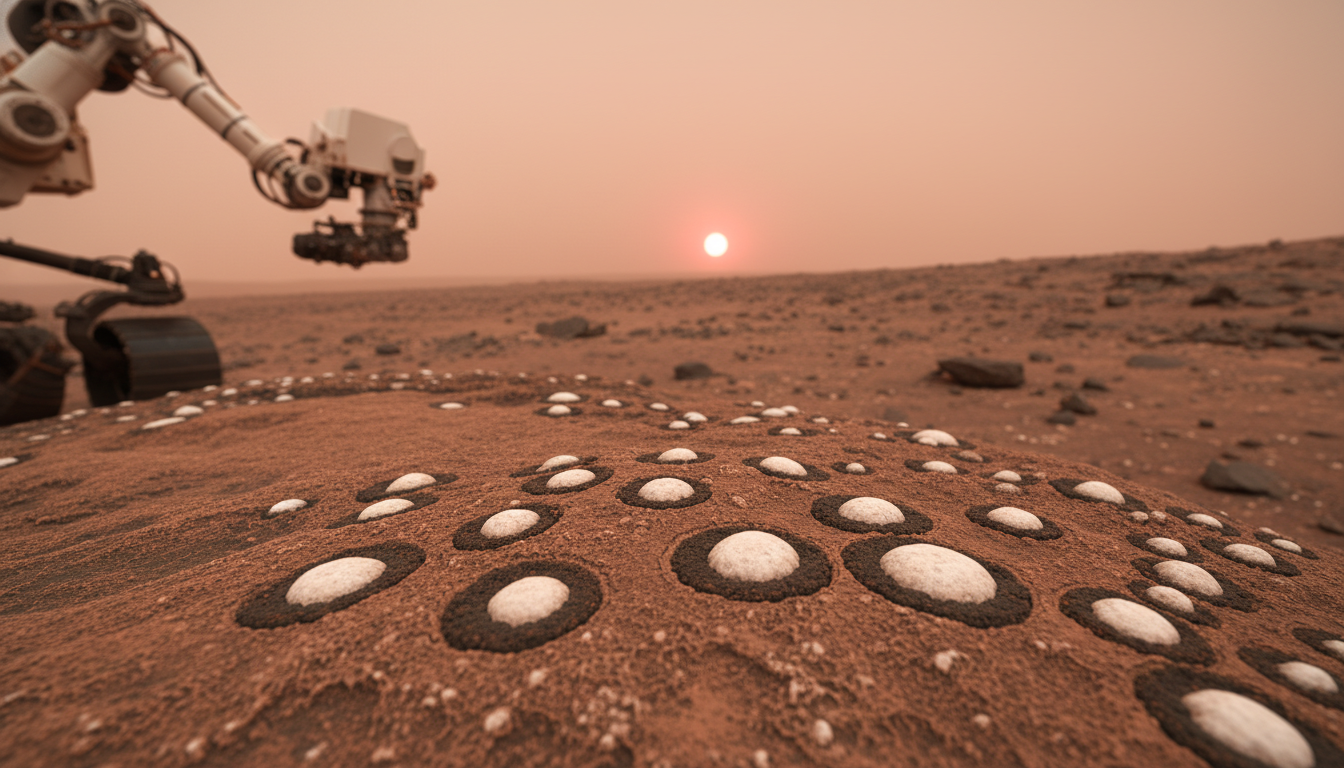
NASA’s Perseverance rover has made its most provocative discovery to date at a rock named Cheyava Falls. While exploring an ancient river valley, the rover identified white spots with black outlines, resembling leopard print, which contain chemical signatures that often indicate microbial life on Earth. This isn’t just another rock; it is a multi-layered mystery containing organic molecules and evidence of water flow from billions of years ago. These leopard spots are particularly exciting because they represent a chemical powerhouse for ancient microbes. On Earth, these types of features in sedimentary rocks occur when chemical reactions involving organic matter create energy that microbes can use. The presence of iron and phosphate within these spots on Mars provides the most compelling evidence yet that the Red Planet may have once been a habitable world. However, the scientific community remains cautious. NASA researchers have noted that these features could also be produced by non-biological, purely geological processes. To solve the mystery once and for all, these samples must be brought back to Earth. The Mars Sample Return mission has now become the most critical objective in modern space exploration, as only terrestrial labs have the sensitivity required to confirm if these spots are truly biological fossils. This discovery comes at a time when the Commercial Space Age is hitting its stride. With private companies like SpaceX and Blue Origin preparing for their own lunar and Martian logistics, the search for life has moved from the fringes of science fiction to the center of global business and geopolitics. The race to be the first nation or company to confirm extraterrestrial life is officially on, and the stakes have never been higher. Ultimately, the leopard spots of Cheyava Falls remind us why we look to the stars. Whether they are the remains of ancient Martian inhabitants or a unique trick of planetary chemistry, they force us to confront our place in the universe. If life once thrived on a neighboring planet, the implications for our future and the possibility of life elsewhere in the cosmos are infinite.