
- Introduction
- I. FUNDAMENTAL RIGHTS (PART III)
- 1. Meaning & Importance
- 2. Features of Fundamental Rights
- 3. Types of Fundamental Rights
- 1️⃣ Right to Equality (Articles 14–18)
- 2️⃣ Right to Freedoms (Article 19)
- 3️⃣ Protection in Criminal Matters (Articles 20–22)
- 4️⃣ Right Against Exploitation (Articles 23–24)
- 5️⃣ Right to Freedom of Religion (Articles 25–28)
- 6️⃣ Cultural & Educational Rights (Articles 29–30)
- 7️⃣ Right to Constitutional Remedies (Article 32)
- 8️⃣ Right to Education (Article 21A)
- 4. Reasonable Restrictions & Suspension
- 5. Landmark Judgments (Value Add)
- II. DIRECTIVE PRINCIPLES OF STATE POLICY (PART IV)
- 1. Meaning & Nature
- 2. Features of DPSPs
- 3. Classification of DPSPs
- 4. Implementation of DPSPs
- 5. Conflict Between FRs & DPSPs
- III. FUNDAMENTAL DUTIES (PART IVA)
- 1. Origin
- 2. List of Fundamental Duties (Article 51A)
- 3. Nature of Fundamental Duties
- IV. COMPARATIVE VIEW (EXAM-FRIENDLY TABLE)
- V. CONTEMPORARY RELEVANCE (UPSC VALUE ADD)
- VI. LINK TO UPSC SYLLABUS
- VII. ANSWER WRITING ENHANCEMENTS
- VIII. UPSC MCQs (PRELIMS LEVEL)
- IX. UPSC MAINS PRACTICE QUESTIONS
- Conclusion
Introduction
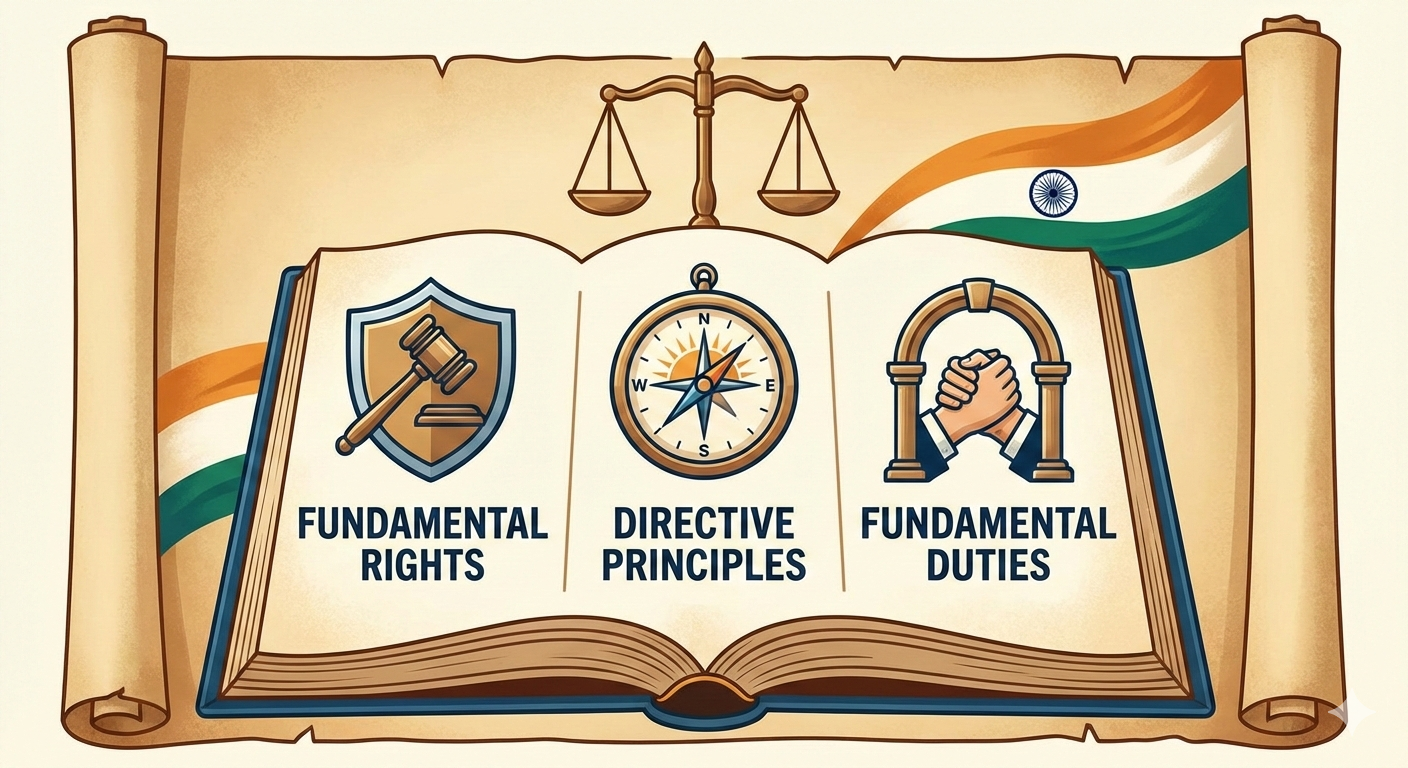
The Fundamental Rights (FRs), Directive Principles of State Policy (DPSPs), and Fundamental Duties (FDs) together form the ethical–constitutional triangle of the Indian polity.
- Fundamental Rights ensure individual liberty and dignity.
- Directive Principles guide the State towards social and economic justice.
- Fundamental Duties remind citizens of their moral and civic responsibilities.
For UPSC, this topic is highly recurring across:
- Prelims (Articles, features, case laws)
- GS-II Mains (rights, welfare state, governance)
- GS-IV Ethics (duties, constitutional morality)
- Essay Paper (democracy, justice, citizen–state relationship)
This article explains the topic in simple language, adds judicial interpretations, current relevance, and provides answer-writing value beyond standard textbooks.
I. FUNDAMENTAL RIGHTS (PART III)
1. Meaning & Importance
Fundamental Rights are basic human freedoms guaranteed by the Constitution to protect individuals from arbitrary state action.
📌 In simple terms:
👉 They act as a shield for citizens against misuse of power.
2. Features of Fundamental Rights
- Justiciable (enforceable by courts)
- Available against the State (Article 12)
- Not absolute (reasonable restrictions)
- Can be suspended during emergency (except Articles 20 & 21)
- Apply to citizens and/or foreigners (depending on the right)
3. Types of Fundamental Rights
1️⃣ Right to Equality (Articles 14–18)
Key Provisions
- Equality before law (Article 14)
- No discrimination (Article 15)
- Equality of opportunity in public employment (Article 16)
- Abolition of untouchability (Article 17)
- Abolition of titles (Article 18)
📌 UPSC Focus:
Article 14 = rule of law + reasonable classification
2️⃣ Right to Freedoms (Article 19)
Six freedoms:
- Speech & expression
- Assembly
- Association
- Movement
- Residence
- Profession
📌 Subject to reasonable restrictions (security, public order, morality)
3️⃣ Protection in Criminal Matters (Articles 20–22)
- No ex-post facto law
- Double jeopardy
- Protection against self-incrimination
- Safeguards against arbitrary arrest
📌 Case: Maneka Gandhi (1978) expanded Article 21.
4️⃣ Right Against Exploitation (Articles 23–24)
- Prohibition of trafficking & forced labour
- Prohibition of child labour in hazardous industries
5️⃣ Right to Freedom of Religion (Articles 25–28)
- Freedom of conscience
- Secularism in Indian sense (equal respect)
📌 Indian Model: Not strict separation but principled distance
6️⃣ Cultural & Educational Rights (Articles 29–30)
- Protect minority culture
- Right to establish educational institutions
7️⃣ Right to Constitutional Remedies (Article 32)
- Right to approach Supreme Court
- Dr. Ambedkar called it the “heart and soul” of the Constitution
Writs:
- Habeas Corpus
- Mandamus
- Prohibition
- Certiorari
- Quo Warranto
8️⃣ Right to Education (Article 21A)
- Added by 86th Amendment (2002)
- Free & compulsory education (6–14 years)
4. Reasonable Restrictions & Suspension
| Situation | Status |
|---|---|
| National Emergency | Most FRs suspended |
| Article 20 & 21 | Never suspended |
| Armed Forces | Restricted application |
5. Landmark Judgments (Value Add)
- Kesavananda Bharati (1973): FRs part of Basic Structure
- Maneka Gandhi (1978): Expanded Article 21
- Puttaswamy (2017): Right to Privacy as FR
II. DIRECTIVE PRINCIPLES OF STATE POLICY (PART IV)
1. Meaning & Nature
DPSPs are non-justiciable guidelines to the State to establish a welfare state.
📌 Simple analogy:
👉 FRs tell what citizens can demand, DPSPs tell what the State must aim for.
2. Features of DPSPs
- Non-enforceable by courts
- Fundamental in governance
- Inspired by Irish Constitution
- Aim at social & economic democracy
3. Classification of DPSPs
(A) Socialist Principles
- Equal distribution of resources (Art 39)
- Equal pay for equal work
- Living wage
(B) Gandhian Principles
- Panchayati Raj
- Promotion of cottage industries
- Protection of cows
(C) Liberal–Intellectual Principles
- Uniform Civil Code (Art 44)
- Free legal aid
- Environmental protection (Art 48A)
4. Implementation of DPSPs
Implemented through:
- Land reforms
- MGNREGA
- Right to Education
- Mid-Day Meal Scheme
📌 DPSPs increasingly enforced through judicial interpretation.
5. Conflict Between FRs & DPSPs
Evolution
- Initially FRs > DPSPs
- Later harmony emphasized
📌 Key Judgments:
- Golaknath (1967)
- Kesavananda Bharati (1973)
- Minerva Mills (1980) – Harmony is part of Basic Structure
III. FUNDAMENTAL DUTIES (PART IVA)
1. Origin
- Added by 42nd Amendment Act, 1976
- Based on Swaran Singh Committee
- Inspired by USSR Constitution
2. List of Fundamental Duties (Article 51A)
Key duties include:
- Respect Constitution & National Flag
- Promote harmony
- Protect environment
- Develop scientific temper
- Safeguard public property
📌 11th duty added by 86th Amendment (parental duty for education).
3. Nature of Fundamental Duties
- Non-justiciable
- Moral obligations
- Aid interpretation of laws
📌 Verma Committee: Suggested legal backing for some duties.
IV. COMPARATIVE VIEW (EXAM-FRIENDLY TABLE)
| Aspect | FRs | DPSPs | FDs |
|---|---|---|---|
| Nature | Justiciable | Non-justiciable | Non-justiciable |
| Aim | Political democracy | Social democracy | Civic responsibility |
| Addressee | State | State | Citizens |
| Part | III | IV | IVA |
V. CONTEMPORARY RELEVANCE (UPSC VALUE ADD)
1. Rights vs Duties Debate
- Excessive rights without duties = governance stress
- Civic duties crucial for democracy
2. Environmental Jurisprudence
- Art 21 + Art 48A + Art 51A(g)
3. Welfare State
- DPSPs drive inclusive policies
- FRs ensure dignity
VI. LINK TO UPSC SYLLABUS
Prelims
- Articles
- Writs
- Amendments
- DPSP categories
Mains – GS II
- FRs
- DPSPs
- Welfare state
- Judicial review
Mains – GS IV
- Duties
- Constitutional morality
- Ethics of citizenship
Essay
- Rights & responsibilities
- Social justice
- Democracy
VII. ANSWER WRITING ENHANCEMENTS
150-Word Model Answer
Q: Examine the relationship between Fundamental Rights and Directive Principles.
Answer:
Fundamental Rights ensure political democracy by protecting individual freedoms, while Directive Principles aim at social and economic democracy by guiding the State towards welfare goals. Though initially conflicting, the Supreme Court has evolved a harmonious interpretation, holding that both are complementary and equally fundamental. The Minerva Mills judgment emphasised that a balance between the two is part of the Basic Structure of the Constitution. Thus, Fundamental Rights without DPSPs would be hollow, and DPSPs without Rights would be authoritarian.
VIII. UPSC MCQs (PRELIMS LEVEL)
Q1. Which Fundamental Right is available only to citizens?
A. Article 14
B. Article 21
C. Article 19
D. Article 22
✅ Answer: C
Explanation: Article 19 freedoms are exclusive to citizens.
Q2. DPSPs are borrowed from which Constitution?
A. UK
B. USA
C. Ireland
D. Canada
✅ Answer: C
Q3. Fundamental Duties were added by which amendment?
A. 44th
B. 42nd
C. 73rd
D. 86th
✅ Answer: B
Q4. Which case established harmony between FRs and DPSPs?
A. Golaknath
B. Minerva Mills
C. Maneka Gandhi
D. ADM Jabalpur
✅ Answer: B
IX. UPSC MAINS PRACTICE QUESTIONS
- Fundamental Rights and Directive Principles are complementary. Discuss.
- Evaluate the role of Fundamental Duties in strengthening democracy.
- How has judicial interpretation expanded the scope of Fundamental Rights?
- DPSPs reflect the vision of a welfare state. Analyse with examples.
Conclusion
The Indian Constitution does not privilege rights over duties or liberty over welfare. Instead, it creates a carefully balanced framework where Fundamental Rights protect dignity, DPSPs ensure justice, and Fundamental Duties sustain democracy. For UPSC aspirants, mastering this triad is essential to understand the spirit, structure, and soul of the Constitution.