
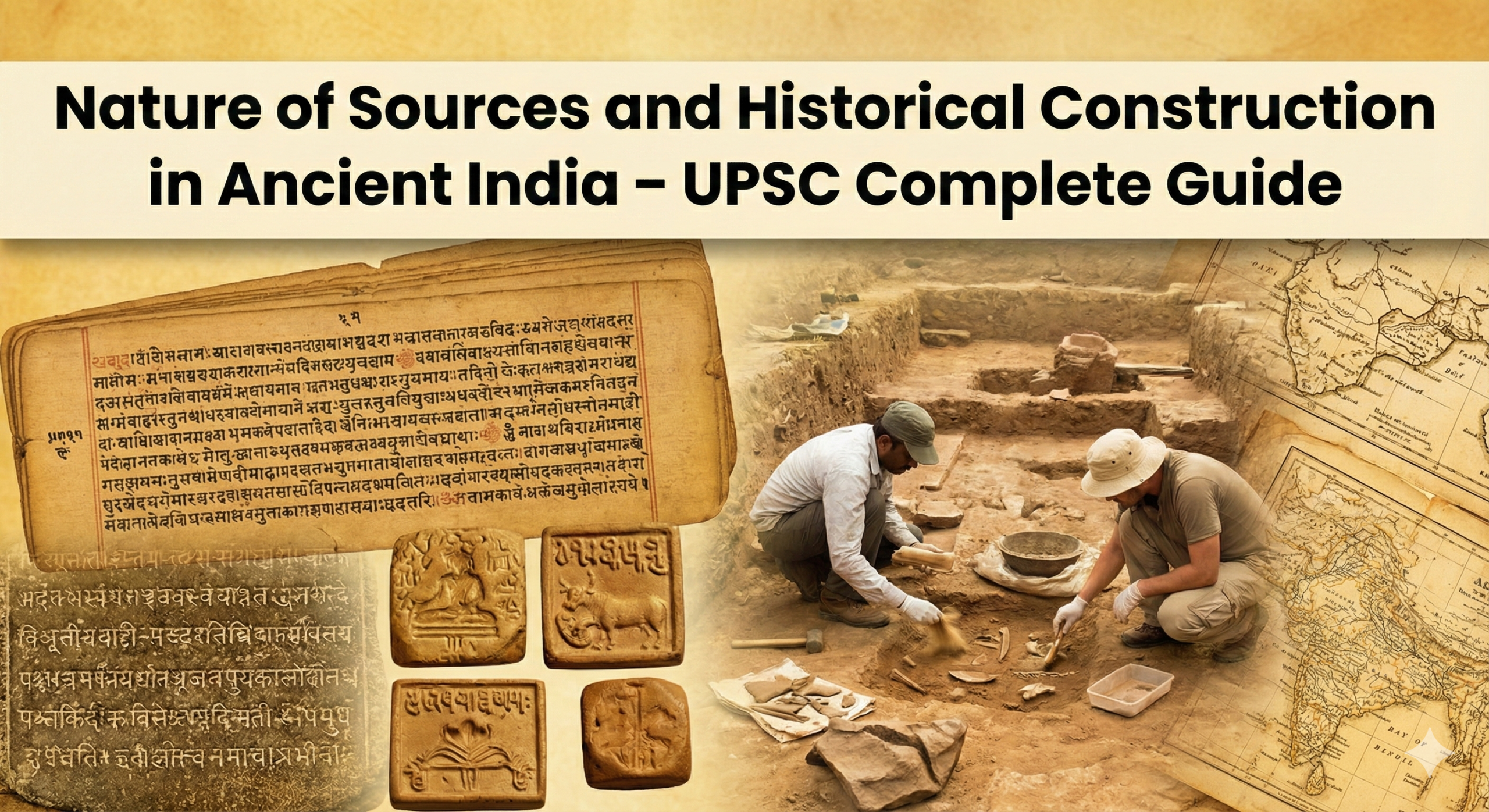
- Introduction
- Classification of Sources of Ancient Indian History
- 1. Archaeological (Material) Sources
- 2. Coins (Numismatic Sources)
- 3. Inscriptions (Epigraphic Sources)
- 4. Literary Sources
- 5. Scientific and Environmental Sources
- Village Studies and Micro-History
- Historical Sense and Construction of History
- Filling the Gaps: What Is Often Missed
- Link to UPSC Syllabus
- UPSC-Style Value Additions
- Answer Writing Enhancements
- UPSC Prelims MCQs
- UPSC Mains Practice Questions
- Conclusion
Introduction
History is not merely a collection of stories from the past; it is a carefully constructed narrative based on evidence. Our understanding of ancient India depends entirely on the quality, variety, and interpretation of sources available to historians. Unlike modern history, ancient India did not leave behind continuous written records, making the task of reconstruction both challenging and analytical.
For UPSC aspirants, this chapter is extremely important because questions are frequently asked on sources of ancient Indian history, their reliability, limitations, and the methods used to construct history. This article explains these aspects in a clear, structured, and exam-oriented manner.
What Are Historical Sources?
Historical sources are materials or evidence that help historians understand and reconstruct past events, societies, economies, and cultures.
Sources do not “speak for themselves”; they must be:
- Critically examined
- Contextualised
- Corroborated with other evidence
Classification of Sources of Ancient Indian History
Ancient Indian history is reconstructed using multiple categories of sources, each with its own strengths and limitations.
1. Archaeological (Material) Sources
What Are Material Remains?
Material remains include physical objects left behind by past societies, such as:
- Tools and weapons
- Pottery
- Buildings and settlements
- Burials
- Art and sculptures
Importance
- Provide direct and objective evidence
- Help reconstruct everyday life of common people
- Essential for prehistoric and protohistoric periods
Examples
- Stone tools → Prehistoric cultures
- Town planning → Early urbanisation
- Pottery styles → Cultural phases
Limitations
- Do not explain beliefs or ideas directly
- Require interpretation
- Often fragmentary
UPSC Focus
Questions on Harappan civilisation, prehistoric cultures, urbanisation rely heavily on archaeological evidence.
2. Coins (Numismatic Sources)
Why Coins Matter
Coins provide information on:
- Political authority
- Economy and trade
- Metallurgical knowledge
- Religious symbols
What Coins Reveal
- Names and titles of rulers
- Chronology of dynasties
- Trade contacts (foreign coins)
- Monetary systems
Limitations
- Mostly related to ruling elites
- Limited social information
Prelims Angle
- Identification of symbols
- Metal usage (gold, silver, copper)
- Foreign trade links
3. Inscriptions (Epigraphic Sources)
What Are Inscriptions?
Inscriptions are writings engraved on stone, pillars, rocks, copper plates, or temple walls.
Types of Inscriptions
- Royal orders and proclamations
- Religious donations
- Land grants
- Eulogies of rulers
Why They Are Crucial
- Contemporary records (high reliability)
- Provide administrative and political details
- Key source for agrarian history
Languages Used
- Prakrit
- Sanskrit
- Tamil
- Telugu and others
Limitations
- Mostly official and elite-centric
- Victories highlighted, failures ignored
4. Literary Sources
Types of Literary Sources
a) Religious Texts
- Vedic literature
- Buddhist and Jain texts
- Puranas
Contribution
- Social structure
- Religious ideas
- Cultural practices
Limitation
- Normative (what should be, not always what was)
- Symbolic and allegorical
b) Secular Texts
- Grammar
- Law books
- Political treatises
- Scientific works
Contribution
- Administrative ideas
- Legal practices
- Knowledge systems
Foreign Accounts
Accounts written by travellers and visitors provide:
- External perspectives
- Comparative observations
- Social and religious practices
Limitation
- Cultural bias
- Limited understanding of local society
5. Scientific and Environmental Sources
Modern Techniques Used
- Radiocarbon dating
- Thermoluminescence
- Palaeobotany
- Climate studies
Importance
- Establish absolute chronology
- Explain rise and decline of settlements
- Link environment with human activity
UPSC Trend
Growing focus on climate, ecology, and human history.
Village Studies and Micro-History
Why Village Studies Matter
- India historically was a village-based civilisation
- Helps understand land relations and agrarian economy
- Bridges gap between texts and reality
Relevance
- Social hierarchy
- Resource distribution
- Local governance
Historical Sense and Construction of History
Historical Sense
Historical sense refers to:
- Awareness of time
- Cause–effect relationships
- Change and continuity
Ancient India did not write history in the modern sense but preserved memory through traditions, genealogies, and cultural narratives.
How History Is Constructed
Sources (material + textual)
          ↓
Critical examination
          ↓
Cross-verification
          ↓
Contextual interpretation
          ↓
Historical reconstruction
Filling the Gaps: What Is Often Missed
1. Bias in Sources
- Elite domination
- Gender invisibility
- Religious dominance
2. Importance of Corroboration
No single source is sufficient; multiple sources must be used together.
3. Role of Ideology
Interpretation is influenced by:
- Political context
- Social values
- Academic framework
UPSC rewards critical awareness, not blind acceptance.
Link to UPSC Syllabus
Prelims
- Sources of ancient Indian history
- Archaeology, inscriptions, coins
- Dating methods
Mains GS-I
- Reconstruction of Indian history
- Role and limitations of sources
- Cultural and social history
Essay Paper
- “History as interpretation”
- “Limits of historical knowledge”
UPSC-Style Value Additions
Keywords
- Archaeology
- Numismatics
- Epigraphy
- Corroboration
- Historical construction
Institutions
- Archaeological Survey of India (ASI)
- National Archives of India
Answer Writing Enhancements
150-Word Sample Answer
Q. Discuss the importance of archaeological sources in reconstructing ancient Indian history.
Introduction:
Archaeological sources form the backbone of ancient Indian history.
Body:
Material remains provide objective evidence of settlement patterns, economy, technology, and daily life, especially where written records are absent.
Conclusion:
Despite limitations, archaeology remains indispensable when used with literary and scientific sources.
UPSC Prelims MCQs
Q1. Which source provides the most direct evidence of ancient material life?
A. Literary texts
B. Inscriptions
C. Archaeological remains
D. Foreign accounts
Answer: C
Q2. Coins are especially useful for studying:
A. Religious philosophy
B. Political chronology and trade
C. Family life
D. Oral traditions
Answer: B
Q3. Why are inscriptions considered reliable sources?
A. They are mythological
B. They are contemporary records
C. They are religious texts
D. They are oral traditions
Answer: B
Q4. Literary sources are limited because they are often:
A. Scientific
B. Normative and idealistic
C. Archaeological
D. Numerical
Answer: B
Q5. Historical construction involves:
A. Memorising texts
B. Critical analysis of sources
C. Rejecting archaeology
D. Ignoring chronology
Answer: B
UPSC Mains Practice Questions
- Examine the role of archaeological sources in reconstructing ancient Indian history.
- Discuss the limitations of literary sources for writing ancient history.
- Why is corroboration of sources essential in historical reconstruction?
- Explain how scientific methods have improved our understanding of ancient India.
Conclusion
The history of ancient India is not discovered—it is constructed through evidence, analysis, and interpretation. Understanding the nature of sources and their limitations enables UPSC aspirants to write balanced, critical, and high-scoring answers in both Prelims and Mains.